Transform the Way You Teach and Learn Chemistry

Engage your students with interactive lessons, real-time analytics, and AI-powered support—before, during, and after class.

Request a Demo

Intro to The Student Experience

Pre-Class Foundation

Exploration

AI Activation

AI Socratic Tutor

AI Activation

AI Constructed Response

AI Activation

AI Page Activation

AI Activation

AI Selected Response

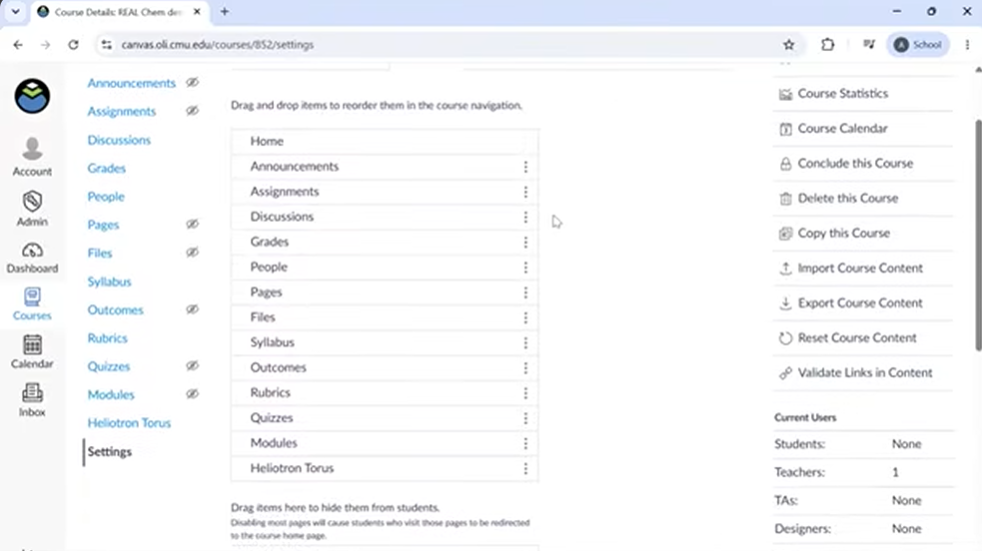
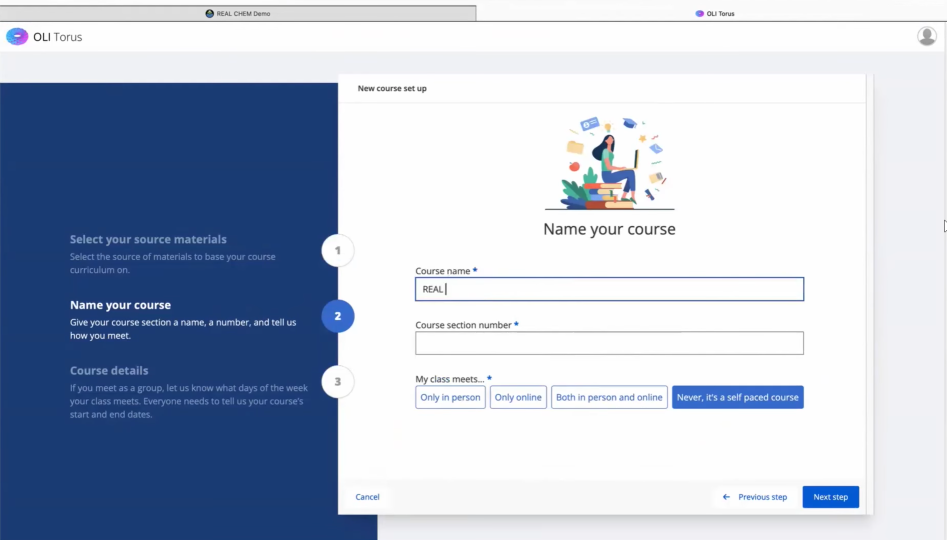
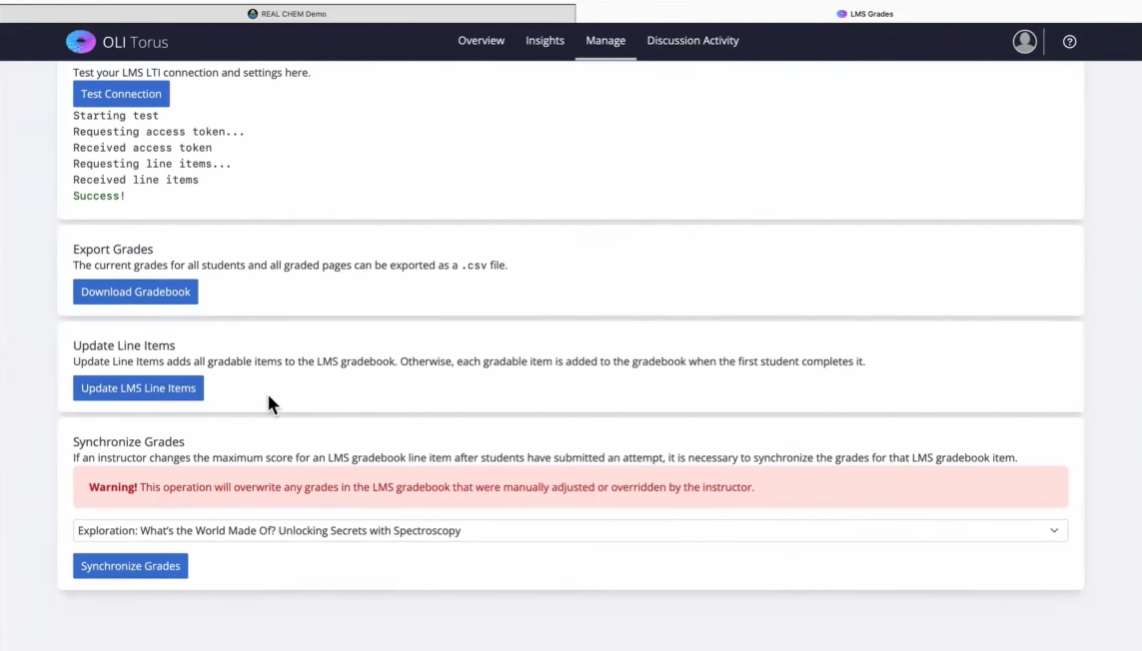
Instructor Pre-Class, LMS set up

Scheduling

Assessment Settings

Roster Management

Instructor Insights to determine In-class activities

In-Class Module Activities

Intro to In-Class Module Activities

In-Class Module Activities

Recommended Actions, Discussions, Class notes, Insights 

In-Class Module Activities

Deliberate Practice

In-Class Module Activities

Score As You Go - Traditional

In-Class Module Activities

Score As You Go - One at a time

Institutional Course Management

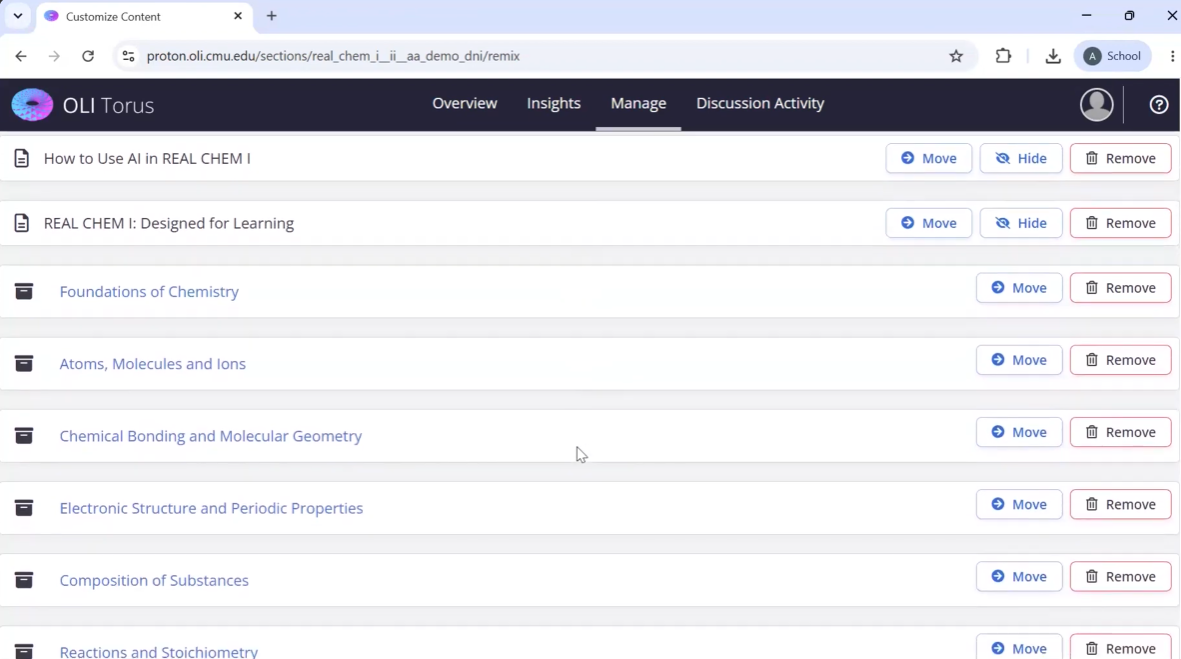
Templates

Institutional Course Management

Catalog Curation via Communities

Institutional Course Management

Support

Institutional Course Management

Payment Setting Template

AI Activation: Meet DOT, Your Digital Online Tutor
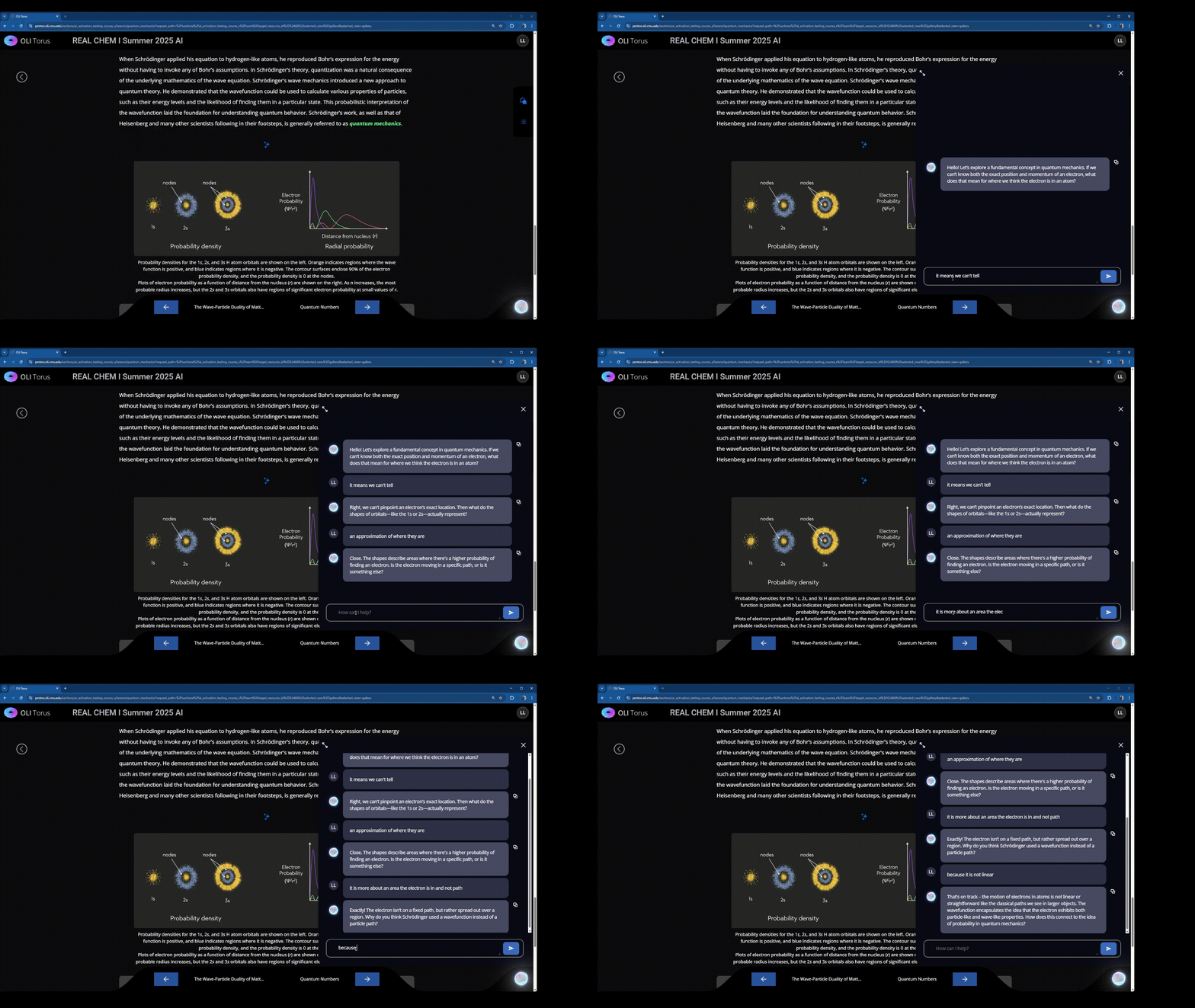
REAL CHEM’s DOT (Digital Online Tutor) brings the power of AI directly into every module. Trained on REAL CHEM’s courseware, DOT isn’t just any chatbot—it understands your course, your assignments, and the way general chemistry is taught in REAL CHEM.
 
From clarifying complex concepts to generating study guides and real-world examples, DOT turns every question into an opportunity to learn. Students can simply click the DOT icon within their course to:
  • Summarize content or explain tricky topics in plain language
  • Explore deeper insights behind examples and quiz questions
  • Receive instant feedback or extra practice problems
  • Get reminders and guidance on due dates or upcoming assignments
Embedded throughout the course experience, DOT keeps learners engaged, confident, and supported—every step of the way.
 
REAL CHEM’s AI activation is about enhancing every moment of learning with responsive, course-aware intelligence.

Make your classes more interactive, intelligent, and effective.

Request DemoWatch the 60-second Tour
01

Chemical Kinetics

  • Introduction to Kinetics
  • Reaction Rates
  • Rate Laws
  • Reaction Mechanisms
  • Exploration: Catalyst in the Clouds
  • Unit Key Equations and Key Terms
  • Chemical Kinetics Unit Checkpoint
02

Chemical Equilibrium

  • Introduction to Chemical Equilibrium
  • Concepts of Chemical Equilibrium
  • Le Châtelier’s Principle
  • Equilibrium Calculations
  • Exploration: Let’s Get the Lead Out!
  • Unit Key Equations and Key Terms
  • Chemical Equilibrium Unit Checkpoint
03

Acids and Bases

  • Introduction to Acids and Bases
  • Defining and Measuring Acids and Bases
  • Strong and Weak Acids and Bases
  • Exploration: Proton Power! pH and Protein Structure
  • Unit Key Equations and Key Terms
  • Acids and Bases Unit Checkpoint
04

Applications of Aqueous Equilibrium

  • Introduction to Applications of Aqueous Equilibrium
  • Buffers
  • Titrations
  • Solubility and Complex Ion Equilibria
  • Unit Key Equations and Key Terms
  • Applications of Aqueous Equilibrium Unit Checkpoint
05

Thermodynamics and Energy → What Drives a Reaction?

  • Introduction to Thermodynamics
  • The Second Law of Thermodynamics
  • Free Energy
  • Unit Key Equations and Key Terms
  • Thermodynamics Unit Checkpoint
06

Electrochemistry

  • Introduction to Electrochemistry
  • Foundational Concepts of Electrochemistry
  • Galvanic Cells
  • Other Applications of Electrochemistry
  • Unit Key Equations and Key Terms
  • Electrochemistry Unit Checkpoint
07

Nuclear Chemistry

  • Introduction to Nuclear Chemistry
  • Nuclear Reactions and Equations
  • Applications of Nuclear Chemistry
  • Unit Key Equations and Key Terms
  • Nuclear Chemistry Unit Checkpoint
08

Transition Metals and Coordination Chemistry

  • Introduction to Transition Metals and Coordination Chemistry
  • Occurrence, Preparation, and Properties of Transition Metals
  • Coordination Chemistry of Transition Metals
  • Spectroscopic and Magnetic Properties of Coordination Compounds
  • Exploration: Dazzling d-Orbitals
  • Unit Key Equations and Key Terms
  • Transition Metals and Coordination Chemistry Unit Checkpoint
09

Appendix (REAL CHEM II)

  • Specific Heats of Common Substances
  • Solution for Large K
  • Solution for Small K
  • Ka Values of Common Weak Acids
  • Kb Values of Common Weak Bases
  • Solubility Products
  • Titration
  • Acid-Base Chemistry of Butterfly Tea and the Ocean
  • Formation Constants for Complex Ions
  • Standard Reduction Potentials
  • Thermodynamic Properties
10

Appendix : PhET Simulations (REAL CHEM II)

  • Gas Properties PhET Simulation
  • Reactions and Rates PhET Simulation
  • Acid-Base Solutions Introduction PhET Simulation
  • pH Scale PhET Simulation
  • Concentration PhET Simulation
  • Salts and Solubility PhET Simulation
  • Build a Nucleus PhET Simulation
  • Radioactive Dating Game PhET Simulation
11

Glossary (REAL CHEM II)

  • Glossary (REAL CHEM II)
12

Instructor only resources (REAL CHEM II)

  • In-class slide decks
  • In-Class Active Learning Activities
  • Learning objectives by module REAL CHEM II
01

Unveiling the Power of Matter and Energy

  • Basic Concepts of Matter and Energy
  • Measurements
02

Unit 2: Atoms, Molecules and Ions

  • Atomic Theory and the Periodic Table
  • Compounds and Chemical Formulas
  • Exploration: Do you really want to drink that? The elements of water.
03

Electronic Structure and Periodic Properties

  • Electromagnetic Energy and the Bohr Model of the Atom
  • Quantum Theory
  • Periodic Properties
  • Exploration: What’s the World Made Of? Unlocking Secrets with Spectroscopy
04

Chemical Bonding and Molecular Geometry

  • Ionic and Covalent Bonding
  • Lewis Structures
  • Molecular Structure and Polarity
  • Advanced Theories of Covalent Bonding
  • Exploration: Decoding the Mystery of Greenhouse Molecules
05

Composition
of Substances

  • Mole Calculations
  • Aqueous Solutions
  • Exploration: Is the Town Toxic? Quantifying Concentrations of Lead.
06

Reactions and
Stoichiometry

  • Chemical Reactions and Equations
  • Chemical Reactions Stoichiometry
  • Exploration: Driving Down Greenhouse Emissions
07

Gases

  • Gas Laws
  • Stoichiometry of Gases
  • The Kinetic-Molecular Theory
08

Thermochemistry

  • Introduction to Energy
  • Calorimetry
  • Enthalpy
  • Exploration: What’s Our Next Big Energy Source?
09

Liquids and Solids

  • Intermolecular Forces
  • Phase Changes
  • The Solid State of Matter
10

Solutions

  • Solubility
  • Colligative Properties

Request a Demo