Insights and innovations for chemistry educators, sparking connections in every lesson.

Across our social platforms, we’ve been sharing stories that illuminate chemistry’s human side. Recent posts have highlighted the scientific breakthroughs behind HIV treatment and prevention, showcasing the work of researchers like Gertrude Elion and Kizzmekia Corbett from our World AIDS Day feature . We also honored Percy Julian during Nobel Week, celebrating his legacy in organic synthesis, materials science, and equity in STEM . These narratives help our community see how chemistry shapes lives, advances healing, and widens access to scientific opportunity.
As you dive into this issue, consider this question: What new connections are you hoping your students will make in the coming term, and how can REAL CHEM support that journey?
I’m always glad to connect, exchange ideas, and spark new reactions together. Looking forward to staying in conversation.
— Dr. Elaine Villanueva Bernal California State University, Long Beach Faculty Innovator, REAL CHEM
Love stories and chemical reactions may seem worlds apart, but according to Dr. Paulette Vincent-Ruz, both are all about the how. In this charming and insightful video, she draws an unexpected but brilliant parallel between the twists of a romance plot and the step-by-step mechanisms that drive chemical reactions.
Using Pride and Prejudice and the Suzuki cross-coupling reaction as case studies, Dr. Vincent-Ruz unpacks how catalysts (like helpful relatives or palladium) help unlikely bonds form, how intermediates represent critical shifts, and why understanding the path from reactants to products is far more interesting than just seeing the end result.
THE STORY OF REAL CHEM
Created in collaboration between Arizona State University and Carnegie Mellon University, REAL CHEM is designed to help educators engage, inspire, and build confidence in their general chemistry students.
Backed by years of teaching experience and learning science research, we are committed to the idea that reaching students with varying levels of academic preparation is the key to boosting their success. That’s why we developed cinematic videos that break down complex concepts, problem-solving assignments using real-world data, and active learning strategies to form the foundation of our courseware.
With over 11,000 students using REAL CHEM across 30 institutions, we’re making an impact on retention and student outcomes. When students see themselves in chemistry, they explore deeper, solve harder problems, and push their understanding further.
Let’s build bonds that last beyond the classroom.
— The REAL CHEM Team
11,000 students are using REAL CHEM

EDUCATOR'S CORNER
Ashley Evanoski-Cole
Associate Professor of Chemistry at Westfield State University

Cozy Up to Combustion Chemistry
As the seasons change from autumn to winter, the weather is becoming cold and blustery here in New England. In the Northern hemisphere, Arctic airmasses are descending towards the Equator and bringing frigid temperatures further south. High- and low-pressure systems are setting up a strong pressure gradient force to create howling winds. Liquid water is solidifying to form freezing rain, sleet, and snow. With this arrival of wintery weather, I have been appreciating the importance of combustion chemistry in our daily lives.
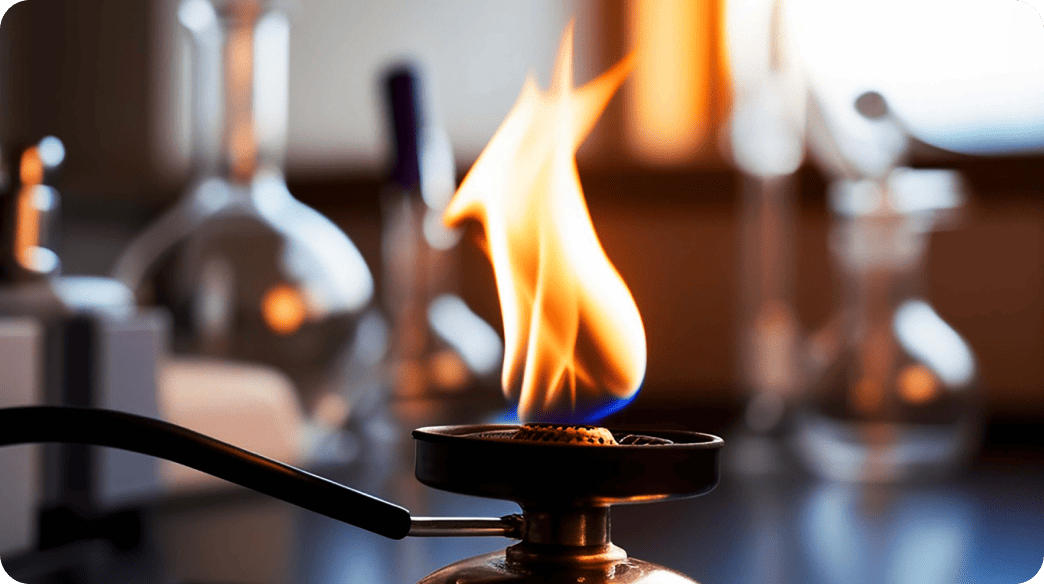
The overall process of combustion is straightforward: Fuel and an oxidant combine to generate heat and produce water and carbon dioxide. However, in practice, the actual products that form also include a complicated mix of by-products. Some of these by-products are harmful to us or the environment and can include carbon monoxide, soot, particulate matter, nitrogen oxides, and a whole host of other pollutants. Carefully controlling both the composition of the reactants, the ratio of the reactants, and the conditions of the reaction will allow for maximum amount of heat produced while minimizing the formation of those unwanted by-products.
Common fuel sources for heating indoor spaces include natural gas, heating oil, liquid propane, wood, kerosene, and wood pellets. The oxidant used is the oxygen gas in the air. Let’s explore using wood as the fuel source and burn it in a fireplace to create a warm and cozy fire. The composition of the wood itself influences how cleanly it will burn. For example, wood with high moisture content will not burn efficiently and therefore generate a lot of smoke and harmful by-products. Another factor related to the stoichiometry of the combustion reaction is the amount of air available. If there is not enough air consistently introduced to the combustion reaction (like if you forget to open the damper!), more of those unwanted by-products will be formed.
If the weather is getting cold where you are, keep your combustion reaction efficient and thank the exothermic process that is keeping you warm!
What's New at REAL CHEM?
REAL CHEM on the EdTech Elevated Podcast

What does it take to make chemistry truly click for students? In two powerful new podcast episodes on EdTech Elevated, REAL CHEM Faculty Innovators share what it means to design learning experiences that resonate across classrooms, campuses, and communities.
In Episode 17, Dr. Gizelle Sherwood of Carnegie Mellon University brings 17 years of teaching experience to a conversation about REAL CHEM’s mission. She explores how chemistry becomes tangible when students can feel its relevance, and how the right digital tools can support that connection. From breaking down barriers to building better learning, Dr. Sherwood shows how innovation can make chemistry more accessible and more human.
Watch the episode on Spotify, Apple Podcasts, and YouTube.

In Episode 18, Dr. Amy Burkert, also of Carnegie Mellon, unpacks REAL CHEM’s early momentum. From adaptive courseware design to creating a true “community of practice,” she highlights how REAL CHEM is rooted in learning science and powered by collaboration. Hear how data, autonomy, and shared vision are coming together to support chemistry educators and learners in transformative ways.
Watch the episode on Spotify, Apple Podcasts, and YouTube.

Events
Upcoming Opportunities
- REAL CHEM Faculty Innovation Webinar Series
Stay tuned and register for upcoming sessions! We’re sharing strategies to make science more welcoming and chemistry more engaging for all learners.
Get Involved with the REAL CHEM Community
Join the REAL CHEM Community of Practice
We’re bringing together chemistry educators who care deeply about making general chemistry better, for students and for the people who teach it.
At REAL CHEM, we believe change starts in conversation. That’s why we’re building a space where faculty can share what’s working, exchange ideas, and help shape new ways of teaching through active learning, real-world relevance, and student connection.
We’re also offering opportunities to collaborate on pilot programs, provide feedback on courseware, and get compensated for your insights.
Let’s reimagine general chemistry together.