Insights and innovations for chemistry educators, sparking connections in every lesson.
As we head into a new semester, I had the chance to reflect on where REAL CHEM has been and where it is going. In a recent podcast conversation with Dr. Ashley Evanoski-Cole, we talk candidly about how students are engaging with the Exploration assignments and how we can better connect that work to lecture and assessment. We also highlight Explorations like water quality and climate change that help students see chemistry as real, global, and relevant.
As you explore this issue, I invite you to think about how your students might experience chemistry differently this semester and where REAL CHEM can help bridge ideas across class, context, and community. I welcome your reflections and look forward to continuing these conversations together.
— Dr. Elaine Villanueva Bernal, Ed.D., California State University, Long Beach; Faculty Innovator, REAL CHEM
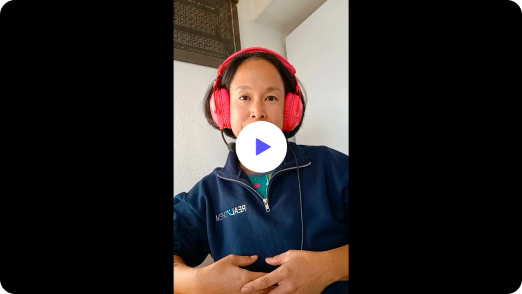
Chemistry comes alive when students can see and feel its impact in their lives.
In this podcast clip from EdTech Elevated, Dr. Elaine Bernal and Dr. Ashley Evanoski-Cole reflect on how REAL CHEM courseware helps students move past barriers like math anxiety and connect abstract concepts to the real world, whether it’s cooking, weather, or exercise.
By making learning more visual, collaborative, and grounded in everyday experiences, REAL CHEM helps students engage with chemistry in a personal and powerful way.
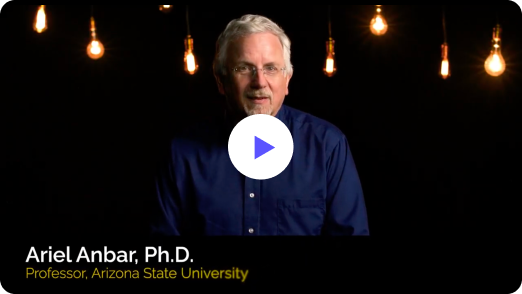
What actually makes a chemical reaction happen, and why do some reactions race ahead while others barely budge? In this video, narrated by Dr. Ariel Anbar, students dig into collision theory and activation energy using an unexpected but memorable analogy: a playground game.
By thinking about molecules as blindfolded players bumping into one another, the video brings three core ideas into focus: how often molecules collide, how they’re oriented when they do, and whether those collisions have enough energy to rearrange bonds. From concentration to activation energy, abstract concepts become concrete, visual, and intuitive.
It’s a clear, engaging way for students to move beyond memorizing equations and start understanding what reaction rates really represent: molecular motion, chance encounters, and energy at work.
THE STORY OF REAL CHEM
Created in collaboration between Arizona State University and Carnegie Mellon University, REAL CHEM is designed to help educators engage, inspire, and build confidence in their general chemistry students.
Backed by years of teaching experience and learning science research, we are committed to the idea that reaching students with varying levels of academic preparation is the key to boosting their success. That’s why we developed cinematic videos that break down complex concepts, problem-solving assignments using real-world data, and active learning strategies to form the foundation of our courseware.
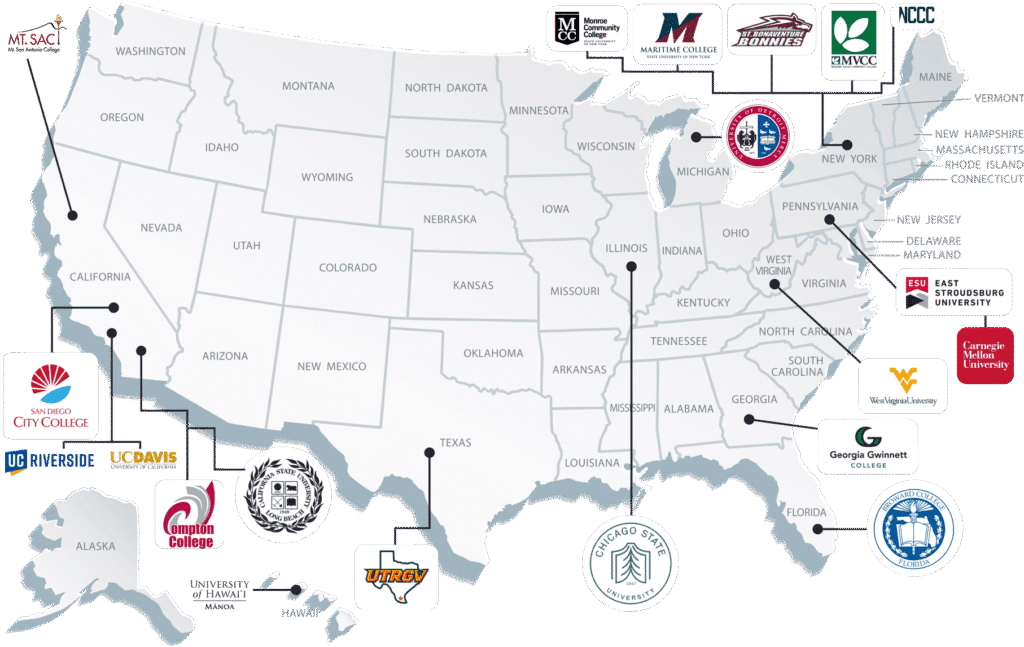
With over 11,000 students using REAL CHEM across 30 institutions, we’re making an impact on retention and student outcomes. When students see themselves in chemistry, they explore deeper, solve harder problems, and push their understanding further.
Let’s build bonds that last beyond the classroom.
— The REAL CHEM Team
11,000 students are using REAL CHEM
EDUCATOR'S CORNER
Ashley Evanoski-Cole
Associate Professor of Chemistry at Westfield State University

Catalysts for the New Year
As we start a new academic semester and new year, some of us will make resolutions. If you have chosen to participate in this tradition, your resolution might include a goal related to physical health, mental health, well-being, finances, or personal growth. To help achieve your goal and actually stick to your resolution, have you also identified a catalyst to increase your chances of success?
A catalyst in chemical kinetics is a compound that lowers the energy required, allowing the reaction to proceed more efficiently. Catalysts are used everywhere: in the digestion process to break down the food you eat, in the manufacturing of materials like plastic, in breaking down harmful pollutants from vehicle exhaust, and in many more reactions that impact you every day. The Haber-Bosch process to produce ammonia is one of my favorite examples to introduce chemical kinetics and the importance of catalysts. On paper, the reaction is deceivingly simple: combine hydrogen and nitrogen gases to produce ammonia. Scaling up the reaction to efficiently produce large quantities of ammonia in an industrial setting has been much more challenging than the straightforward reaction suggests. Fritz Haber was awarded the Nobel Prize in Chemistry in 1918 for his work developing a method to produce ammonia and Carl Bosch shared the Nobel Prize in Chemistry in 1931 for his contributions in developing high pressure methods for ammonia production. In addition to the high temperature and high pressure conditions to speed up the formation of ammonia, an iron-based catalyst was also essential to reasonably scale up this reaction for the large-scale manufacturing of ammonia.
The chemical reaction in the Haber-Bosch process is also a strong contender for being one of the most important chemical reactions in human history by enabling mass production of nitrogen-based fertilizer needed for large-scale food production to sustain the growing human population. Without catalysts, there would not be enough nitrogen available for fertilizer. However, the industrial production of ammonia is the highest emitter of carbon dioxide of any industrial chemical reaction, significantly contributing to global greenhouse gas emissions and climate change. So what can be done to reduce the carbon footprint of ammonia production? One possible solution is catalysts! Finding greener methods to produce ammonia is currently an active area of research. Some creative ideas include using different materials for catalysts or incorporating catalysts during different stages of the manufacturing process to reduce the overall energy consumption needed to produce ammonia.
If you are contributing to the high percentage of folks who have trouble sticking to that New Year’s resolution, maybe the solution is to find an effective catalyst to lower the required energy to move your goal within reach!

What We’re Reading
Curated by Dr. Elaine Villanueva Bernal
- Scientists have developed a surprisingly simple chemical approach that could help break down “forever plastics,” offering a potential path toward addressing one of the most persistent environmental challenges. Read more here.
- Researchers are finding new ways to turn agricultural byproducts into environmental solutions. In California, almond waste may help clean winery wastewater, showing how chemistry can support sustainability across industries. Read more here.
- A new AI-powered tool is dramatically reducing the computing power needed to identify protein-binding molecules, accelerating drug discovery and highlighting how chemistry and machine learning are increasingly intertwined. Read more here.
What's New at REAL CHEM?
We’ve rolled out major updates to REAL CHEM II, designed to give instructors more flexibility, clarity, and cutting-edge tools to support student learning.
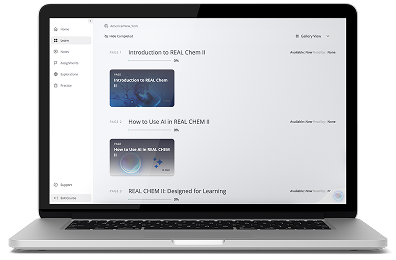
Here´s a glimpse at what´s new
- AI-Powered Support: Expanded use of our Digital Online Tutor (DOT) with new activation points and open-ended prompt features to provide smarter, context-aware help.
- Refined Learning Objectives: Sub-objectives are now clearly listed at the top of every module, with updated metacognitive reflection tools to help students track their own progress.
- Updated Checkpoints & Feedback: Enhanced feedback alignment, new Socratic tutor prompts, and better checkpoint design to match learning outcomes.
- New Mini-Explorations: Dive into real-world chemistry with additions like “Is It Gold?” and “Space Station Emergency.”
- Accessibility & Functionality: All images now include alt text and are optimized for dark mode, with reduced error reports across Chem I and Chem II.
Also: REAL CHEM on the EdTech Elevated Podcast
This month on the EdTech Elevated podcast, Dr. Elaine Villanueva Bernal (University of California, Long Beach) is joined by Dr. Ashley Evanoski-Cole (Westfield State University) for a thoughtful conversation about how chemistry becomes meaningful when students can see, feel, and relate to it.
Together, they reflect on how REAL CHEM courseware has helped reshape their classrooms, sharing practical ways chemistry can connect to everyday experiences like cooking, weather, and exercise, and how digital tools like REAL CHEM make abstract topics easier to grasp.
Watch the episode on Spotify, Apple Podcasts, and YouTube.

Events
Upcoming Opportunities
- REAL CHEM is headed to BCCE!
We’re excited to share that REAL CHEM will be at the Biennial Conference on Chemical Education (BCCE) this summer, taking place July 26–30, 2026 on the beautiful lakeside campus of the University of Wisconsin-Madison.
Join us to explore how REAL CHEM helps reimagine general chemistry through evidence-based instruction, engaging simulations, and equitable learning design. Let’s connect and talk about what’s next in chemistry education.
- REAL CHEM Faculty Innovation Webinar Series
Get Involved with the REAL CHEM Community
Join the REAL CHEM Community of Practice
We’re kicking off 2026 by restarting our REAL CHEM Community of Practice (CoP) meetings! These monthly gatherings are a space to share strategies for using REAL CHEM in your classroom and use your own course data to inform instruction and explore publishable research.
At REAL CHEM, we believe change starts in conversation. That’s why we’re building a space where faculty can share what’s working, exchange ideas, and help shape new ways of teaching through active learning, real-world relevance, and student connection.
We’ll host two meetings each month covering the same topic to increase accessibility. Scheduling poll and exact dates coming soon—stay tuned!