

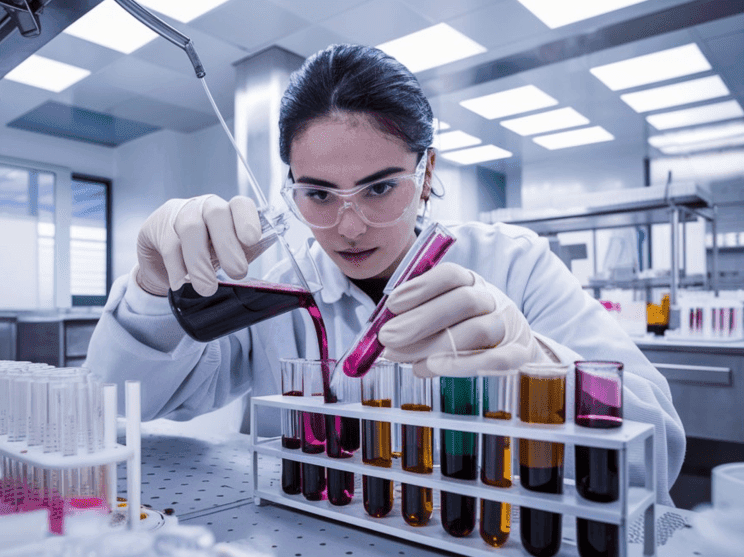
When students open Real Chem, they’re stepping into more than an online chemistry course…they’re entering a platform built entirely around how people actually learn.
According to Dave Yaron, REAL CHEM’S lead subject-matter expert and professor of chemistry at Carnegie Mellon University, the result is a product that meets learners where they are, providing tailored support that encourages success for all students. “The research driving the development of the courseware makes the content better, and it helps everyone learn faster,” he says.
Adapted from CMU’s Open Learning Initiative general chemistry courseware, REAL CHEM is a two-semester introductory chemistry courseware for postsecondary STEM students. It is a joint venture of Arizona State University’s (ASU’s) Center for Education Through Exploration (ETX) and Carnegie Mellon University’s (CMU’s) Open Learning Initiative (OLI)—two institutions with a shared commitment to advancing learning through research and design.
Meeting Learners Where They Are
At the heart of Real Chem is a simple premise backed by recent studies: when the design is right, all students (no matter their starting point) can learn at the same pace.
Yaron and fellow researchers found that differences in performance often stem not from how quickly students learn, but from how much prior knowledge they bring into the course. Real Chem bridges that gap by adapting to each learner’s needs in real time.
Interactive assessments and AI-driven tutoring identify where students need support and provide just-in-time guidance, while instructor dashboards reveal common stumbling blocks across classes. The result is a learning environment that acts more like a coach than a course as it guides students from their first exposure to final mastery.
Connecting Chemistry to the Real World
Every feature of Real Chem is designed to make chemistry feel relevant and attainable:
- Cinematic Videos: High-quality presentations that show chemistry’s relevance to students and their lives.
- Explorations: Invite students to experiment, test, and discover through hands-on, inquiry-based learning.
- Formative Assessments: Personalized feedback that keeps progress on track.
- AI-Powered Tutoring: Offers support as students need it.
The instructional design of REAL CHEM draws on the science of teaching and learning, including a 2025 study co-authored by Yaron. It examines the importance of prior math preparation in chemistry education and arrives at a surprising finding at the heart of REAL CHEM: With good design, it is possible for all students to learn at the same pace irrespective of prior learning.
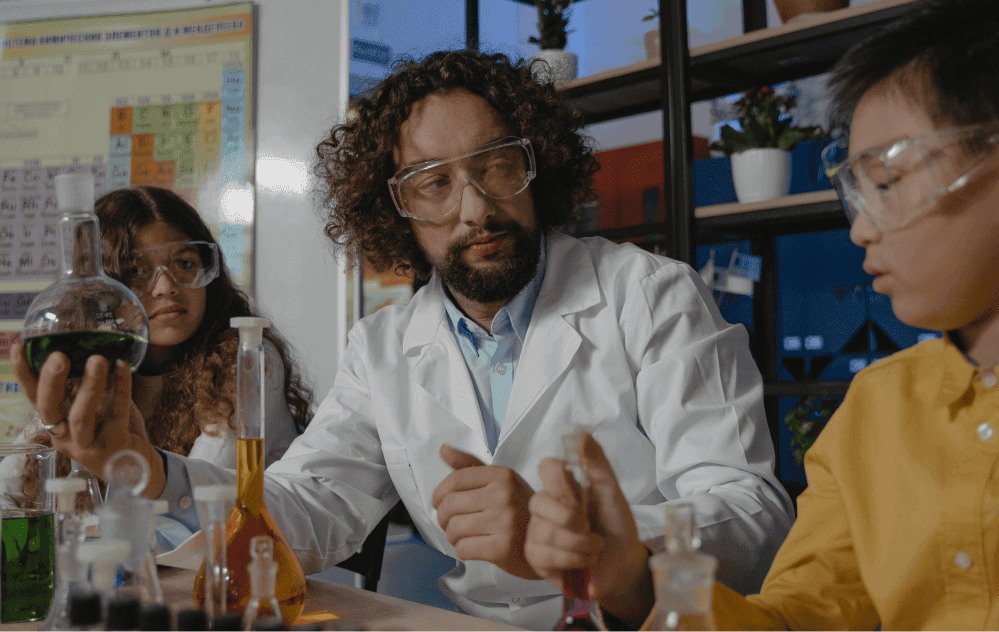
Recognizing Equality in Learning Rates
That finding echoes a 2023 study of how students learned across math, science, and language courses. Unlike prior studies focused only on pre and post-tests, this research tracked students’ answers throughout their classes to measure progress in mastering material. It also spanned grade levels, from elementary through postsecondary education, to determine whether, and why, learning pace differed.
Though researchers expected high-achieving students to learn faster, they discovered that everyone’s rate of learning was similar.
The difference, they found, was that less successful students started with less prior knowledge than their higher-achieving peers. This meant those students were already behind when they began, creating a gap that equal learning rate didn’t overcome.
“So, a student coming in with the least amount of pre-knowledge is going to take much longer to learn the content,” Yaron says, “because they start at very different points.”
To close that gap, REAL CHEM acts as a coach, helping students gain the basic knowledge they lack even as they master introductory chemistry. Tailored assessments show what they need to understand to learn new material, while instructor dashboards highlight areas where classes struggle.
“It’s a smooth, flowing system,” says Yaron, “a coherent experience for students starting all the way from initial learning to final practice.”
Rethinking the Role of Math
One of Yaron’s recent studies revealed something surprising: students’ math preparation didn’t predict how quickly they learned chemistry. That finding challenges the idea that college-level math must precede general chemistry.
Instead of separating math and chemistry, Real Chem integrates them by embedding hints and guided practice that help students connect quantitative reasoning directly to chemical concepts. The approach lets learners apply what they already know, reducing barriers that often keep them from advancing in STEM.
Data-Driven Improvement, Year After Year
REAL CHEM isn’t static, it’s a living research project. Since its initial rollout in 2023, usage data has shown major gains: in one study, students scored 19 percentage points higher on midterms than peers in traditional sections, and another institution saw a 17 percentage-point increase in STEM retention after adopting the courseware.
For Yaron, each year’s findings feed directly into product updates. “We take the research side seriously,” he says. “Every improvement builds on the last, like engineering the modern car. Over time, those incremental changes lead to dramatic results. Maybe one day, we’ll have doubled student learning rates.”
Looking Ahead
As REAL CHEM continues to evolve, its mission stays the same: make chemistry education equitable, engaging, and effective for every student. With a foundation built on data, collaboration, and the science of learning, the team is proving that meaningful change in STEM education starts with rethinking how students learn and giving every learner the tools to succeed
Want to see how REAL CHEM could fit into your course?
Connect with a REAL CHEM rep to explore the platform and get started.