

REAL Reactions
Insights and innovations for chemistry educators, sparking connections in every lesson.

“I started thinking, surely we can use technology to teach science better,” he says. “That set me down a path to creating projects that were all about using digital technologies at scale to teach science as a process.”
Ariel Anbar came to this conclusion soon after he began teaching introductory chemistry courses in the School of Molecular Sciences at Arizona State University (ASU) in 2004.
Now Anbar is co-principal investigator of REAL CHEM, general chemistry courseware that pairs Arizona State University's Education Through Exploration (ETX) with the Open Learning Initiative (OLI) at Carnegie Mellon University. Together, they developed courseware that bridges abstract chemistry concepts with real-world applications, while maintaining essential college-level rigor.
The core instructional design principles informing REAL CHEM are built into the name—Relevant, Engaging, Active Learning. Anbar and his colleagues are committed to the idea that courseware built on those practices can benefit all students.
When chemistry clicks, confidence soars.
At REAL CHEM, we’re not just teaching science—we’re sparking joy, empowerment, and a love for learning.
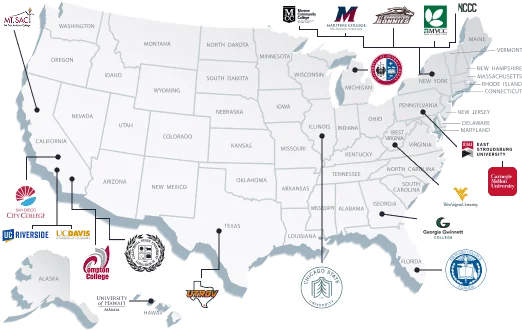
11,000 students are using REAL CHEM
THE STORY OF REAL CHEM
Created in collaboration between Arizona State University and Carnegie Mellon University, REAL CHEM is designed to help educators engage, inspire, and build confidence in their general chemistry students.
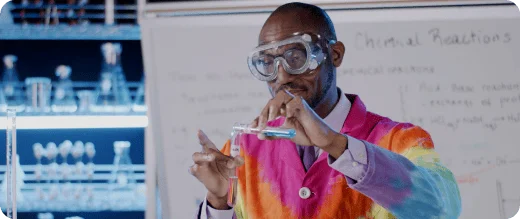
Backed by years of teaching experience and learning science research, we are committed to the idea that reaching students with varying levels of academic preparation is the key to boosting their success. That’s why we developed cinematic videos that break down complex concepts, problem-solving assignments using real-world data, and active learning strategies to form the foundation of our courseware.
With over 11,000 students using REAL CHEM across 30 institutions, we’re making an impact on retention and student outcomes. When students see themselves in chemistry, they explore deeper, solve harder problems, and push their understanding further.
Let’s build bonds that last beyond the classroom.
— The REAL CHEM Team
EDUCATOR'S CORNER
Amy E. Irwin, PhD
Chemist/OBM Dr. of Documents
Faculty Ambassador, REAL CHEM
My passion for chemistry began in high school. It wasn’t always easy, but I was fascinated by how it explained the world.
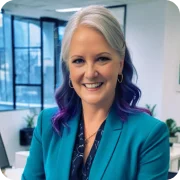
During undergrad I had my son, which made the journey harder but more meaningful. I earned a PhD in Inorganic Chemistry, completed post-doctoral research, and taught large General Chemistry courses.
I later led an Environmental Radiochemistry Lab supporting the U.S. Navy and then taught Radiochemistry and Organic Chemistry at a community college while caring for my son and ailing mother. I connected deeply with students balancing similar challenges.
After my mother passed, I joined a college in Kentucky serving first-generation students like me. I later returned to teaching in New York before moving into industry, working in quality management and systems engineering.
Chemistry taught me to adapt, write clearly, and explain complex ideas—skills that reach far beyond the lab. Now, I run my own business and am excited to be working with REAL CHEM as a faculty ambassador!

Chemistry in the News
Sparking Discussion with your Students
Green Chemistry is a branch of chemistry focused on designing and using chemicals that minimize pollution and hazardous waste. A key area of emphasis is reducing the impact of everyday chemicals used in homes and personal products.
Hypochlorous acid (HOCl) is a non-toxic, skin-safe cleaner and weak acid that’s powerful enough to kill even the most stubborn viruses, including COVID-19 and norovirus—the infamous culprit behind cruise ship outbreaks. Amazingly, our bodies naturally produce HOCl as part of the immune response when fighting infection or healing wounds.
But don’t confuse it with sodium hypochlorite, the harsh chemical found in household bleach. Why focus on hypochlorous acid? Because it’s an incredibly effective germ-killer. So why isn’t it more widely known?
As highlighted in Scientific American’s article, “The Nontoxic Cleaner That Kills Germs Better Than Bleach—And You Can Use It on Your Skin,” author Jen Schwartz explains how earlier challenges with HOCl’s stability (especially exposure to air and light) limited its use. But recent innovations have solved those issues, making it possible to safely harness this compound in everyday cleaners—for hands, kitchens, and beyond.
It’s safe, it’s effective, and it was well worth the wait.
– Amy E. Irwin, PhD
NEW!
Updates to REAL CHEM I & II Rolling Out this Fall!
Give your students a tour of the chemical world, the REAL CHEM way!
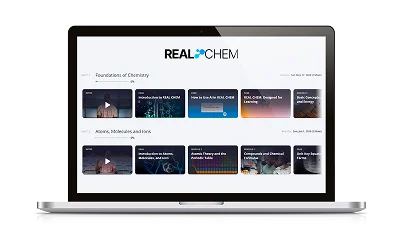


Interested in learning more about these new features?
Click here to schedule a demo with our team
JOIN US!
This summer, the Chemistry Education (CE) track at the LearnLab Summer School at Carnegie Mellon University is your chance to dive into real classroom data and advance your research skills. Perfect for educators, researchers, and learning scientists who want to explore how students learn—and contribute to meaningful, data-driven insights.
Events
Come meet the REAL CHEM team
July 20-25, Golden, CO

Oct. 27-30, Nashville, TN

Get Involved with
the REAL CHEM Community
Join general chemistry faculty in MERLOT’s REAL CHEM Innovation Project for professional development and research opportunities.
Opportunities to participate include:
To learn more



4 comments
Mark Marvin
you are in reality a good webmaster The website loading velocity is amazing It sort of feels that youre doing any distinctive trick Also The contents are masterwork you have done a fantastic job in this topic
Rosamond Medhurst
Your blog is a treasure trove of valuable insights and thought-provoking commentary. Your dedication to your craft is evident in every word you write. Keep up the fantastic work!
legendlinkmaya
Smart bankroll management is key in any game, especially with higher stakes. Seeing platforms like legendlink maya integrate GCash & PayMaya is a huge plus for Filipino players – accessibility matters! Solid security is a must too.
68winapp
That’s a fascinating point about player engagement – it’s not just about the games, but the whole experience! Seeing platforms like 68win app online casino focus on streamlined onboarding (like secure logins) is smart. It builds trust & keeps players coming back for more, especially with those high-stakes games!
Comments are closed.